Semi-Automatic or CNC Tube Bender – What’s the Better Move?
Which type of bender do you need: semi-automatic or CNC? Learn how to make an informed decision on the best tube bender for your needs.
Read BlogImagine walking into a woodworking facility and the air is crystal clear, despite saws cutting
through lumber. This is the work of dust collectors doing their job.
In manufacturing, where air quality continues to be a major point of content, dust collectors have
been pivotal in tackling dust challenges. Whether you’re battling sawdust, metal shavings, or
fine powder particles, understanding the capabilities of dust collectors could be key to
understanding exactly what your facility needs. Let’s explore industrial dust collection and
discover why these systems have become the unsung heroes of clean air.
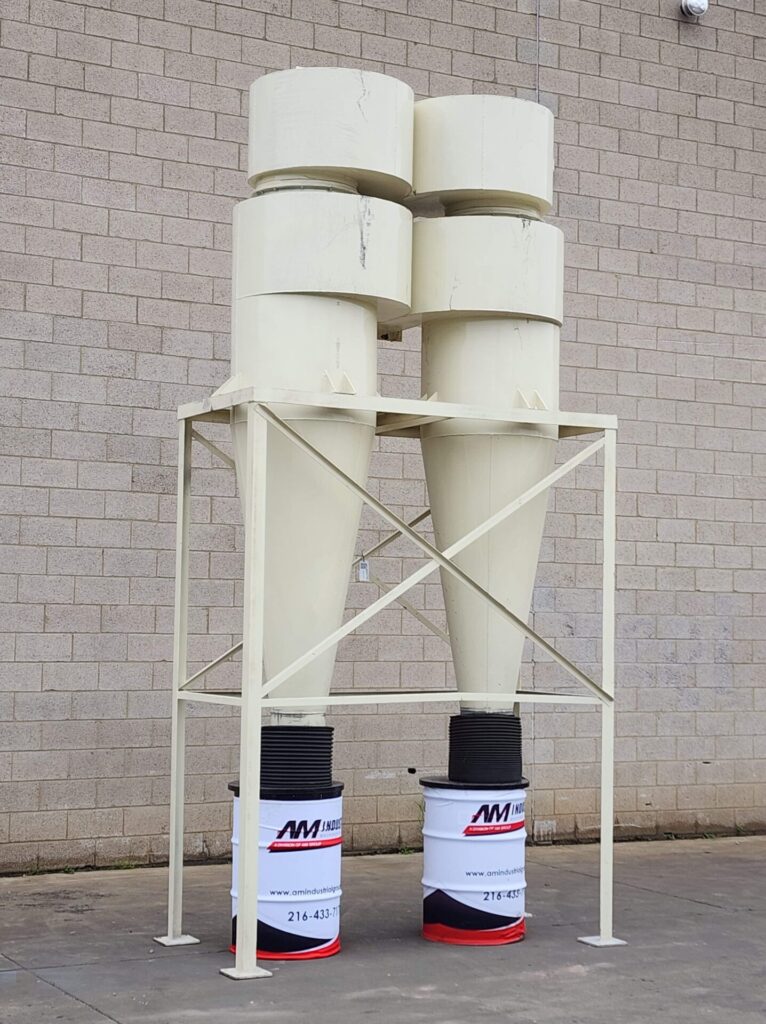
Picture a miniature tornado contained within an industrial-grade cone – that’s essentially what happens inside a cyclone dust collector. These devices are marvels of engineering that turn basic physics into a powerful cleaning force. They are mechanical devices that create a controlled vortex of spinning air, much like a tornado or whirlpool, but with a very specific purpose. When contaminated air enters the system, it’s forced into a spiral pattern, creating what engineers call a “cyclonic flow.” As this air spins rapidly down the cone-shaped chamber, centrifugal force – the same force that keeps water in a bucket when you swing it – pushes dust particles and debris outward against the collector’s walls. While heavier particles are flung outward and spiral down into a collection bin, the cleaned air moves upward through the center of the vortex and exits through the top.
Cyclone dust collectors are remarkable for their simplicity. Unlike some other types of dust collection systems that rely on expensive filters or complicated mechanisms, cyclone collectors achieve impressive results through pure physics. In some cases, there are no filters to replace, no bags to clean, and no complex parts to maintain, reducing maintenance issues and ensuring consistent performance over time.
Continuous operation is another huge benefit. While other systems frequently stop for maintenance or filter changes, cyclone collectors keep working. This is particularly important in high-production environments where every minute of downtime translates to lost revenue.
Cyclone collectors also excel at heavy particle removal efficiency. They capture everything from chunky wood shavings to bulky metal chips. In addition to cleaning the air, these systems protect your expensive equipment, ensure product quality, and maintain a safer work environment.
Finally, space efficiency cannot be understated – cyclone collectors offer a compact footprint. Their vertical design takes advantage of overhead space rather than valuable floor area, allowing facilities to maximize their layout. A single cyclone unit can often replace larger, more space-hungry filtration systems while delivering equal or better performance.
The versatility of dust collectors is evident in their wide range of applications across industries. In the woodworking industry, these systems excel at collecting wood chips and sawdust while providing essential pre-separation before fine filtration, protecting downstream equipment. Food processing facilities benefit from cyclone dust collectors through efficient separation of food particles and powders, enabling ingredient recovery and maintaining clean process air.
In manufacturing environments, these systems handle metal dust, plastic particles, and general industrial waste. The pharmaceutical industry relies on cyclone dust collectors for powder recovery, process dust collection, and product separation, where maintaining clean air is crucial for product quality and worker safety.
Cyclone dust collectors are straightforward to operate. Contaminated air enters the system at high speeds, typically between 3,500-4,500 feet per minute, creating a powerful spiral motion inside the collector. This spinning action generates centrifugal force, which throws particles outward against the cyclone walls while clean air moves toward the center and exits through the top. The system’s performance relies on four critical factors: inlet velocity, the physical dimensions of the cyclone, the size of particles being collected, and the rate of air flow through the system.
Cyclones are most effective at capturing particles between 10-100 microns in size, with collection efficiency exceeding 90% for larger particles but dropping below 70% for very fine particles. The design elements that most impact performance include the height-to-diameter ratio, inlet configuration, cone angle, and collection bin capacity. Make sure to match these specifications to your needs and regularly monitor pressure and flow rates for best performance.
Maintaining a cyclone dust collector is relatively easy but requires attention to detail. The collection bins need regular inspection and emptying, typically on a schedule determined by the volume of collected material – allowing bins to overfill can significantly reduce the system’s efficiency and potentially cause backups. Wear patterns, particularly along the cyclone walls where particle impact is highest, should be monitored monthly to catch potential issues. A pressure drop across the system serves as a vital performance indicator – a sudden increase might indicate blockage, while a gradual increase could suggest internal buildup that requires cleaning.
Your system’s performance depends on maintaining the proper air velocity. This can be accomplished through regular inspection and cleaning of the inlet and outlet areas, ensuring they remain clear. The internal surfaces of the cyclone should be cleaned regularly, depending on the type and volume of material being collected. Pay special attention to areas where material might accumulate, such as the cone section and collection bin interface. All seals and gaskets require regular inspection and should be replaced when worn to prevent air leaks that could compromise the system’s efficiency.
Daily visual inspections, weekly performance checks, and monthly thorough examinations will prolong the life of your cyclone dust collector and prevent bigger issues. Daily tasks include checking collection bin levels and listening for unusual noises. Weekly checks should focus on pressure gauge readings and basic cleaning of accessible parts. Monthly maintenance might involve more detailed inspections of internal components, seal integrity checks, and wear pattern analysis.
First, thoroughly assess your facility’s specific needs and operating conditions. The most critical factor is understanding your particle size distribution – cyclones are most effective at capturing particles between 10 and 100 microns, so knowing your dust characteristics is essential for picking the right machine. The system’s efficiency requirements must align with your environmental and production standards, typically ranging from 70% to 99% depending on the particle size.
Space considerations also play a vital role, as you’ll need to account not only for the cyclone’s physical footprint but also for proper inlet and outlet ductwork clearance and maintenance access. Evaluate operating costs, including energy consumption, maintenance requirements, and potential downtime for servicing. The characteristics of your material, such as its abrasiveness, moisture content, and tendency to stick or clump, will significantly influence the design choices – for instance, more abrasive materials might require stronger wall materials or special coatings.
Finally, consider your airflow requirements and system capacity, as these will determine the size and number of cyclone units needed. Properly evaluating these factors, preferably with the guidance of an experienced manufacturer or engineer, will ensure that the cyclone dust collector you’ve picked meets your immediate needs and long-term operational goals.
Cyclone dust collectors are a reliable, efficient, and cost-effective solution for several industrial applications. Their simple design, minimal maintenance requirements, and versatility make them an excellent choice for many facilities. Understanding your specific needs and application requirements will help you determine if a cyclone dust collector is the right choice for your operation.
Need help selecting the right dust collection system for your facility? View our used cyclone dust collector inventory or contact AM Industrial today for a personalized consultation and find the perfect solution for your specific needs.
Semi-Automatic or CNC Tube Bender – What’s the Better Move?
Which type of bender do you need: semi-automatic or CNC? Learn how to make an informed decision on the best tube bender for your needs.
Read BlogHow to Bend Pipe Using a Pipe Bending Machine
Watch how a Pines #4 horizontal heavy-duty tube bender can bend 4" pipe efficiently.
Read BlogProper Tube Bending Terminology Part 2: Describing Bent Tubes
Learn more about tube bending terminology by understanding the characteristics of a bent part that can assist you in describing it to a supplier or a customer.
Read BlogAM Industrial Group sells industrial machinery to customers around the globe. If you have a question about any of our products or inventory, you may contact us at info@amindustrialgroup.com, support@amindustrialgroup.com for after-sales questions and support, or simply provide your information on the following form.
"*" indicates required fields