Precision Performance: A Guide to Selecting Exhaust & Muffler Pipe Benders
Fabricating high-performance exhaust systems is a game of fine margins. You̵…
Read BlogVisit us at AMI Plastics World Expo – Booth #R2506 – Nov. 11-12 – Huntington Convention Center - Cleveland, OH
Fabricating high-performance exhaust systems is a game of fine margins. You’re constantly balancing material integrity against flow dynamics, and when you’re working with thin-walled 409 or 304 stainless steel, the margin for error shrinks even further. The most common headaches we see are wall thinning, excessive ovality, and flow restrictions that kill horsepower. Getting a repeatable, professional result every time depends entirely on the mechanical capabilities of your exhaust pipe bender.
Whether you’re an industrial fabricator, a procurement officer, or part of an engineering team, your choice of machinery dictates your throughput. For some, a specialized muffler pipe bender for local repair work is the right move. For others, a high-output CNC system for header production is the only way to stay competitive. At AM Industrial Group, LLC, we’ve helped countless shops navigate these technical trade-offs to find the equipment that actually moves the needle for their production.
At its core, an exhaust pipe bender is designed to manipulate tubing into specific shapes while maintaining the cross-sectional area as much as possible. However, not all bending methods are created equal. Depending on your specific application, you’ll likely be looking at one of three primary methods:
The volume and complexity of your work usually dictate which “tier” of machinery you need. For a deeper breakdown of how manual, hydraulic, and CNC systems stack up across materials and production volume, see our complete guide to tube and pipe bending machines.
For a dedicated muffler shop or a general automotive repair facility, a manual or semi-automatic ram bender is often the most cost-effective solution. These machines are designed for “while-you-wait” service. They don’t require complex programming, and they’re perfect for bending aluminized or mild steel tubing for standard exhaust replacements. If your goal is to quickly mimic a factory tailpipe, this is your workhorse.
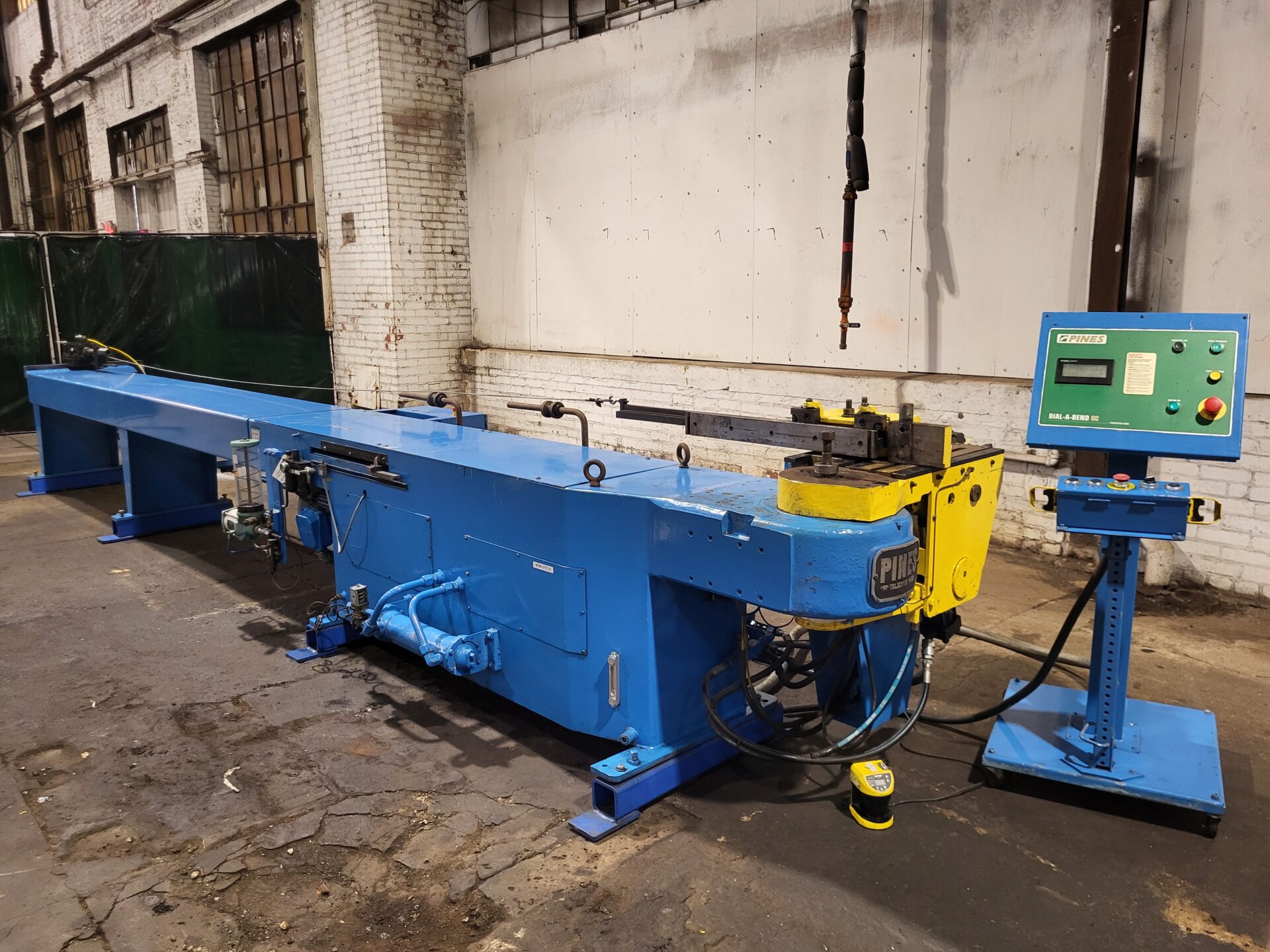
When you move into performance fabrication or small-batch manufacturing, the limitations of ram bending become clear. This is where a hydraulic mandrel-type bender comes into play, giving fabricators the control and repeatability that ram bending can’t match. The 3″ Pines #2 Tube Bender is an example of what’s available in our inventory.
These units typically feature pressure die assist and programmable controls, allowing you to handle tougher materials like stainless steel with far more precision. The addition of a mandrel and a wiper die ensures that the outside wall doesn’t thin out too much and the inside wall doesn’t wrinkle. If you’re starting to take on header work or custom turbo manifolds, upgrading to a hydraulic mandrel system is usually the first major leap in quality. For a closer look at how these systems work and where they excel, check out our simplified guide to hydraulic tube bending.
If you’re an OEM supplier or a high-volume performance brand, you can’t afford to have a technician manually set every bend angle. CNC (Computer Numerical Control) benders automate the entire process: the plane, the distance between bends, and the degree of the bend itself.
CNC tube benders take that precision a step further, delivering the repeatability high-volume production demands. Many of these systems support heavy-duty marine and industrial exhaust applications, and come equipped with advanced controls that interface directly with CAD software, turning a digital design into a finished part in minutes. Browse our full lineup of CNC Tube Benders to find the right fit for your shop.
Before you pull the trigger on a machine, you need to look at your “worst-case scenario” part. What’s the hardest bend you’ll ever have to make? Here are the specs that matter:
Material choice changes everything in the bending process.
The Stainless Steel Divide
Exhaust work is increasingly moving toward stainless steel for its longevity, but not all stainless is the same.
Exotic Materials
For top-tier racing or aerospace exhaust, you might encounter titanium. It has a very narrow plasticity window, meaning it’s easy to crack if you don’t handle it correctly. You’ll often need to manage heat and use specialized tooling to get clean bends in titanium without compromising the metal’s structure.
f your business involves headers, turbo manifolds, or any part where flow restriction is unacceptable, the answer is usually yes. In a standard bend, the outside of the tube stretches (thinning the wall) and the inside compresses (often wrinkling). A mandrel bender uses internal support to keep the tube’s shape.
When you combine a mandrel with a wiper die, which sits just behind the bend die to “wipe” the material as it’s drawn, you get a bend that’s as smooth on the inside as it is on the outside. That’s non-negotiable for high-end performance work where every CFM of flow counts.
We see a wide variety of shops using this equipment, and the “right” machine depends on the end product:
Often, the bend is only half the job. You also need to join those tubes together. This is where tube-end forming comes in:
AM Industrial also stocks muffler machinery that goes beyond bending. This equipment covers seaming, joining, and spinning operations, rounding out a complete muffler fabrication line. Explore our full range of Muffler Machinery to see what fits your production needs.
How do I know what size bender I need? Always look at your maximum OD and your heaviest wall thickness.
Can I bend both mild steel and stainless on the same machine? Yes, but you’ll need to account for springback. Stainless steel has a much higher springback rate than mild steel, meaning the machine has to bend the tube “past” the target angle so it settles back to the correct position. CNC machines make this easy by letting you save different springback profiles for different materials.
Is a refurbished CNC machine a good investment? Absolutely. A pre-owned CNC bender, especially one with a modern control upgrade like BendPro, offers the same precision as a brand-new unit at a fraction of the cost. Because these machines are built with heavy-duty cast frames, they can last for decades when they’re properly maintained.
Navigating the pre-owned machinery market shouldn’t be a gamble. At AM Industrial Group, we specialize in sourcing and refurbishing high-quality metalworking equipment.
Whether you’re looking for a reliable tube former for your custom shop or a heavy-duty Schwarze Wirtz Robitec for an industrial contract, we provide the transparency and technical support you need. Our inventory of pre-owned and refurbished equipment is one of the largest in the industry, and we’re here to help you find the exact specs required for your next project.
Choosing the right exhaust pipe bender is about more than just matching a tube diameter. It’s about understanding your material, your volume, and the final performance requirements of your exhaust systems. By moving from simple ram bending to precision mandrel or CNC systems, you can eliminate the flow restrictions and wall-thinning issues that hold your shop back.
Ready to upgrade your production floor or have questions about a specific machine? Our team is ready to help you find the perfect fit.
Precision Performance: A Guide to Selecting Exhaust & Muffler Pipe Benders
Fabricating high-performance exhaust systems is a game of fine margins. You̵…
Read Blog
Inside Our Process: How We Refurbish Used Dust Collectors for Peak Performance
When a facility manager or plant operations director considers purchasing a used…
Read Blog
Can a Used Dust Collector Pass an NFPA Check? A Brief Overview.
For facility managers and shop owners, the decision to purchase a used dust coll…
Read BlogAM Industrial Group sells industrial machinery to customers around the globe. If you have a question about any of our products or inventory, you may contact us at info@amindustrialgroup.com, support@amindustrialgroup.com for after-sales questions and support, or simply provide your information on the following form.
"*" indicates required fields